20 Litre Wort Cooling Time: Comparing Evidence for Summer Tap Water
Short answer: For a useful comparison of 20 litre wort cooling time, ask for the actual batch volume, starting temperature, numerical finishing temperature and operating conditions beside the time.
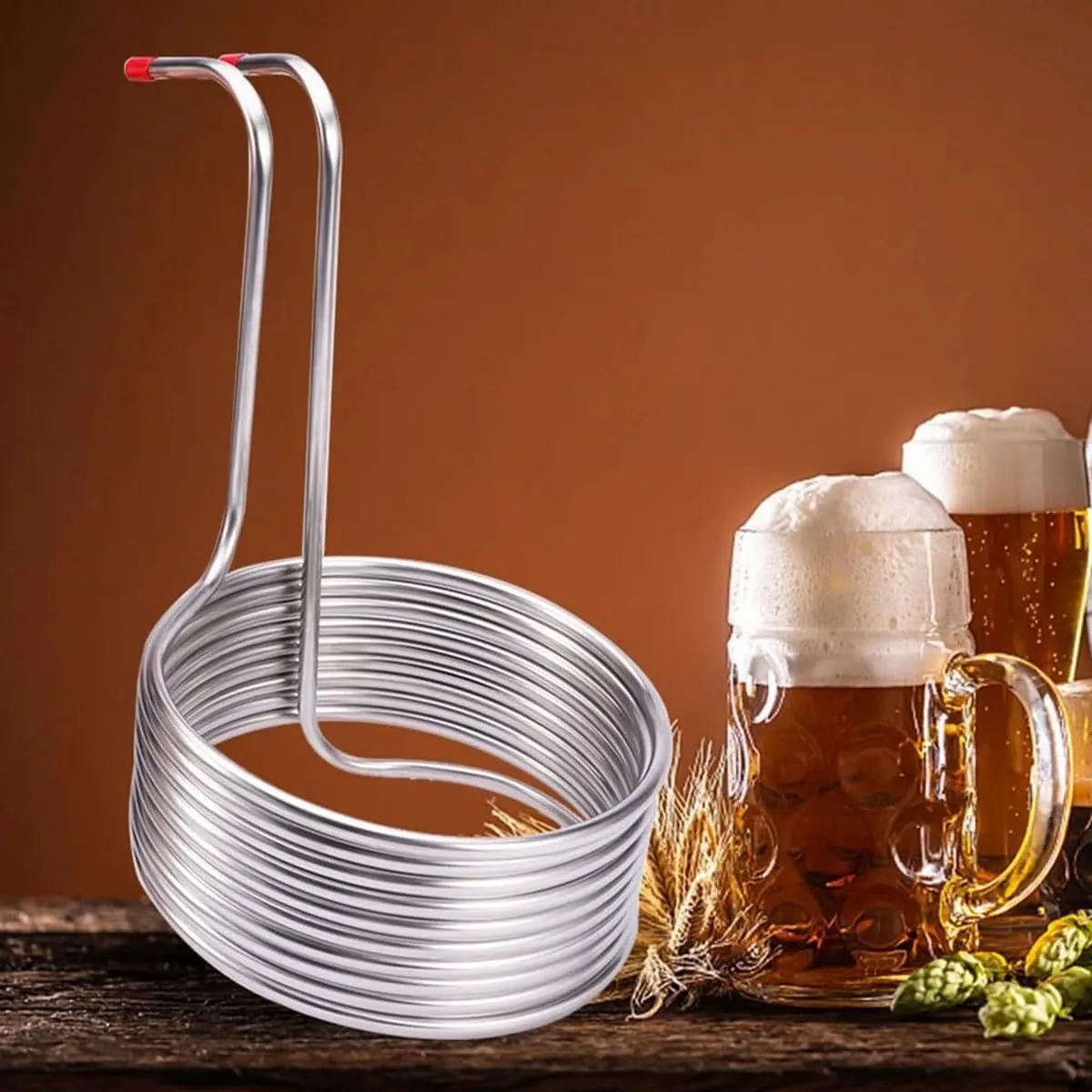
What a 20-litre cooling time can tell you
For a useful comparison of 20 litre wort cooling time, ask for the actual batch volume, starting temperature, numerical finishing temperature and operating conditions beside the time. Use this guide’s proposed checklist to assess whether the evidence matches your summer water supply and intended ale pitching temperature.
BeerCoolin’s listing describes a typical 20-litre batch cooled from boiling to 20°C in approximately 15–20 minutes, depending on tap-water temperature and stirring frequency. Those qualifications belong with the time whenever you quote it.
Distinguish three kinds of evidence:
- A seller’s statement: identify the product, the claimed result, its qualifications and unspecified conditions.
- An observed run: inspect the dated readings and setup record. Keep the conclusion specific to that run.
- A comparison designed to isolate differences between chillers: check which conditions were kept consistent, which changed and how they were measured. Request individual records for repeated runs.
These are proposed assessment rules. Neither a product headline nor one successful run should be your sole basis for predicting a different setup’s finishing time.
This guide’s contribution is a way to examine cooling claims and a reusable blank log. It does not rank chillers or identify a universally fastest model. Its two published examples are attributed seller statements, rather than independent measurements under matched summer conditions.
Define your batch and pitching target
Define your test with three entries: the actual volume being cooled in the kettle, the measured wort temperature when timing starts and your intended numerical pitching temperature. Use the following worksheet as a proposed way to set the comparison boundary.
Record kettle capacity and planned fermenter volume separately. Enter the liquid volume actually being cooled, together with the method used to measure or estimate it. For a 20-litre comparison, request a stated test volume rather than assuming that “standard batch” means 20 litres.
Specify the event that starts the timer, such as cooling water beginning to flow, and take a starting wort-temperature reading at that event. When quoting a listing that says “from boiling”, retain that wording; request a measured starting temperature for the underlying test.
Treat your intended ale pitching temperature as an input. Enter the numerical target selected for your yeast and recipe, and note the guidance used to choose it. This worksheet does not prescribe one temperature for every ale yeast.
Blank batch-and-target worksheet — no product results entered
| Field | Your entry |
|---|---|
| Actual liquid volume in the kettle at the start, litres | |
| Test liquid: wort or water | |
| Volume measurement or estimation method | |
| Measured starting wort temperature, °C | |
| Event used to start the timer | |
| Intended ale pitching temperature, °C | |
| Yeast guidance or recipe used to select the target | |
| Thermometer and probe position |
As a proposed reporting rule, use “time to the recorded temperature” whenever the run ends above your target. Retain the actual final temperature and elapsed time, and mark the target as not reached during the recorded period. Leave the time to an unrecorded endpoint unknown.
Match the inlet water, flow and wort movement
For this guide’s proposed comparison method, record measured inlet-water temperature, actual coolant flow and wort movement beside every result. These entries let you identify differences between the published test and your setup without assigning an unsupported cooling-time correction.
BeerCoolin expressly qualifies its approximate timing by tap-water temperature and stirring frequency. Its quoted timing statement gives no numerical inlet temperature, measured flow or defined stirring schedule.
KegLand states, in instructions for its own stainless immersion chiller, that agitating the hot wort while water flows through the coil aids heat transfer from the wort to the coil. Keep that explanation attributed to KegLand’s product. It does not establish a measured BeerCoolin time saving.
Use this conditions checklist when requesting or recording a test:
| Condition | Proposed record | How to use it |
|---|---|---|
| Inlet-water temperature | Temperature in °C at the chiller inlet, measurement location and time; repeat alongside later readings | Check whether the test actually documents water temperatures comparable to yours |
| Coolant flow | Measured litres per minute through the connected arrangement, measurement method and times | Compare measured values; keep tap position and pump labels in separate setup notes |
| Wort movement | Still, intermittent stirring, continuous stirring or pumped circulation; tool, schedule or return route | Check whether the method is described well enough to repeat |
| Coolant route | Supply and discharge, or reservoir and return | Identify the liquid source and any changes during the run |
| Kettle context | Model, relevant internal dimensions, liquid depth and obstructions | Retain the physical context of the recorded result |
| Coil immersion | Installed position, immersed height and any exposed turns | Describe the setup without treating it as proof of compatibility |
In this log, use coolant recirculation to mean cooling water returned to a reservoir, and wort recirculation to mean wort returned to the kettle. Name the liquid moved by each pump and describe its route. “Recirculated” on its own is too ambiguous for this proposed record.
The available product passages do not quantify how changes in inlet temperature or actual flow would change BeerCoolin’s cooling time. Keep those effects unquantified when assessing a different setup; the checklist supports identifying differences, rather than calculating their consequences.
For clearance and small-batch immersion depth, consult the separate fit assessment, 35L BrewZilla Immersion Chiller Fit: Clearance and Small-Batch Depth. Keep a fit decision separate from a cooling-time comparison, and request product-specific confirmation before assuming compatibility.
Read the whole cooling curve
Read a cooling curve by comparing elapsed time with measured wort temperature, using matching numerical endpoints. The following is a proposed reading method: put elapsed time on the horizontal axis, wort temperature on the vertical axis and retain the individual recorded points alongside any connecting line.
First check the actual volume, test liquid and starting temperature. Mark your intended pitching temperature, then inspect whether the readings reach it. Keep inlet temperature, measured flow and wort movement beside the graph. Label any coolant-stage change at its recorded time.
Hypothetical example: your target is 20°C, but a run’s last reading is 24°C. Report “24°C at the last reading; 20°C not demonstrated”. Keep the final point visible and leave the time to 20°C unknown. These are invented example inputs, not product measurements.
Inspect the later readings as well as the early drop. As a proposed test method, choose consistent reading intervals and add readings near the target. If intervals differ, examine both the temperature change and the elapsed time between points. Describe any observed flattening using the actual values; leave its cause unresolved without suitable supporting evidence.
Do not extend a measured line to an assumed finishing time. If two readings fall on opposite sides of the target, retain both and report the crossing interval. Identify the first recorded reading at or below the target separately from any estimated crossing time.
Blank curve worksheet — no measured cooling curve supplied
| Elapsed time, min:sec | Wort temperature, °C | Inlet-water temperature, °C | Measured coolant flow, litres/minute | Stage, wort movement and changes |
|---|---|---|---|---|
Use the setup and completion records in the final section with this table. Label each result consistently as “target reached”, “stopped above target” or “target not demonstrated by the supplied readings”.
A prediction of the final approach towards coolant temperature needs more than this reading method. The available evidence does not establish that behaviour or its assumptions, so this guide gives no extrapolated finishing time.
When summer tap water needs a different finishing stage
Use your measured inlet temperature and final wort readings to decide what finishing-stage evidence to request. The proposed decision point is practical: if a recorded run stops above your intended pitching temperature, its time to that target remains unknown. Consider a different finishing arrangement as a separate option to assess, with its suitability and performance documented.
For warmer summer water, apply these proposed checks:
- Write down your numerical pitching target and the measured temperature of water entering the chiller.
- If the inlet is at or above your target, flag the proposed finish for specific technical verification. Treat this as a screening rule, rather than a proven temperature limit.
- Examine the final time–temperature readings. If the temperature drops become smaller over equal intervals, report that observed pattern with the corresponding inlet readings.
- Keep any run ending above target visibly incomplete. Request evidence for the remaining stage rather than assuming that additional time will achieve the target.
The available evidence does not establish the coolant-temperature limit and its assumptions, or explain how much warmer inlet water changes the final approach. A physical explanation and a reliable prediction for that stage remain unresolved. Neither a numerical summer correction nor a promise that waiting longer will finish the chill is supported here.
KegLand’s instructions for its own stainless immersion chiller describe pumping wort through the coil and back to the boiler, with the coil immersed in ice and water. This is a documented example belonging to that product. It does not confirm that BeerCoolin permits the same fluid path or establish a BeerCoolin finishing time.
When assessing a colder finishing arrangement, distinguish wort passing through a coil in a cold bath from coolant passing through a coil immersed in wort. Request product-specific documentation for the proposed fluid path, pump and component ratings, connections and operating instructions before choosing an arrangement.
Add these fields to your log if a finishing stage is tested. They are proposed recording fields, rather than setup instructions:
| Finishing-stage field | Your entry |
|---|---|
| Elapsed time and wort temperature at the switch | |
| New coolant source and measured inlet or bath temperature | |
| Reservoir volume, if used | |
| Ice quantity and later additions, if used | |
| Pump identification and liquid being pumped | |
| Actual measured flow and measurement method | |
| Discharge destination or reservoir return route | |
| Wort movement and subsequent changes | |
| Actual final wort temperature and total elapsed time |
Keep the switching point visible in the results. Describe a combined run as a run with a changed finishing stage, and judge it against its actual final temperature.
What the published product examples establish
Read each published example with its own product identity, endpoint and conditions. The passages below establish what the sellers state; they do not supply a matched warm-water test.
BeerCoolin’s product listing states:
For a typical 20-litre batch, our chiller can drop the temperature from boiling to 20°C in approximately 15 to 20 minutes, depending on your tap water temperature and how frequently you stir the wort.
Brew2Bottle’s listing for the Brewferm Chill’in 20 SST states:
This wort chiller cools 20 litres of boiling wort to 20-25 °C in 20 minutes, using cooling water at 13 °C.
| Detail in the quoted statement | BeerCoolin | Brewferm Chill’in 20 SST, as listed by Brew2Bottle |
|---|---|---|
| Batch | Typical 20 litres | 20 litres |
| Start | Boiling | Boiling |
| Endpoint | 20°C | 20–25°C |
| Time | Approximately 15–20 minutes | 20 minutes |
| Inlet-water condition | Timing depends on tap-water temperature; no numerical value in the quoted statement | Cooling water at 13°C |
| Wort movement | Timing depends on stirring frequency; no defined schedule in the quoted statement | Not specified in the quoted statement |
| Measured flow | Not specified in the quoted statement | Not specified in the quoted statement |
No BeerCoolin raw cooling log or measured summer cooling curve is supplied with the material available for this guide. Its measured inlet temperature, actual flow, stirring schedule, repeated-run variation and time–temperature readings therefore remain unverified here. This does not establish that no such records exist elsewhere.
Keep the Brewferm example’s 13°C cooling-water condition and 20–25°C endpoint attached to its timing. For a 20°C target, request the time to 20°C specifically; do not treat an endpoint range as evidence that every recorded run reached its lower end.
These statements do not establish performance under identical warm-water conditions or support a winner. As a proposed next step, request individual logs for matching actual volumes, measured starts, numerical targets, inlet temperatures, measured flows and wort-movement methods. Until then, use the statements as conditional product claims, with applicability to your particular summer setup unconfirmed.
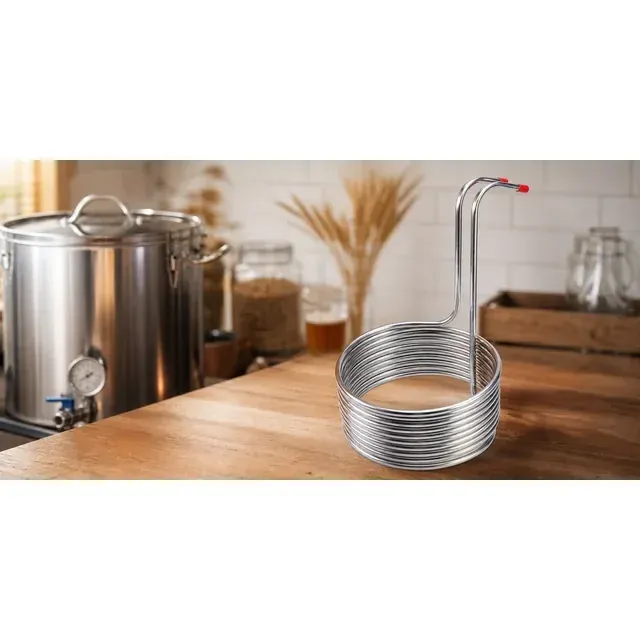
Record a repeatable cooling test
Use this copyable log as a proposed method for documenting your own runs. It is a blank worksheet, not a validated test standard or a record of product performance. Complete a separate copy for each run; mark unmeasured values “not measured” rather than entering assumptions.
Setup record
| Field | Your entry |
|---|---|
| Run identifier and date | |
| Chiller make, model and modifications | |
| Test liquid: wort or water | |
| Actual volume being cooled, litres | |
| Volume measurement or estimation method | |
| Kettle model, relevant internal dimensions and obstructions | |
| Liquid depth and installed coil position | |
| Immersed coil height or turns; any exposed turns | |
| Measured starting wort temperature, °C | |
| Intended numerical pitching endpoint, °C | |
| Yeast guidance or recipe used to choose the endpoint | |
| Event used to start the timer | |
| Coolant source and initial inlet temperature, °C | |
| Measured coolant flow through the connected arrangement, litres/minute | |
| Wort movement: still, stirring schedule or circulation route | |
| Coolant supply, discharge or reservoir return route | |
| Pump identification and setting; liquid moved by each pump | |
| Hoses and fittings used | |
| Thermometer identification, stated accuracy and checks performed | |
| Wort probe position and reading method | |
| Inlet-temperature measurement location and method | |
| Flow-measurement method, including collection volume and timing if used | |
| Planned reading intervals and repeat-run procedure |
Raw readings
Choose reading intervals before the run as part of your proposed procedure. Retain the initial reading, add rows as needed and record extra readings when conditions change. Keep a continuous elapsed-time record across coolant stages.
| Elapsed time, min:sec | Wort temperature, °C | Inlet coolant temperature, °C | Measured coolant flow, litres/minute | Stage, wort movement and changes |
|---|---|---|---|---|
For a changed finishing stage, add the switching time and wort temperature, coolant source, measured inlet or bath temperature, reservoir volume, any ice additions, pump, actual flow and discharge or return arrangement. Identify the liquid moved by each pump. These are recording fields, rather than instructions to build an arrangement.
Completion record
| Field | Your entry |
|---|---|
| Actual final wort temperature, °C | |
| Total elapsed time | |
| Intended target reached during the recorded period: yes or no | |
| First recorded time at or below target, if reached | |
| Readings bracketing the target, if applicable | |
| Coolant-stage switching times and temperatures | |
| Total fresh water supplied, litres, if measured; measurement method | |
| Reservoir water and ice quantities, if used and measured | |
| Interruptions, missed readings and other deviations | |
| Raw-reading file or notebook reference |
Keep any above-target final reading visible. If readings bracket the target, report the interval and the first recorded reading at or below it; identify any estimated crossing time as an estimate.
Before publishing product performance findings, use this proposed evidence checklist: request the owner’s raw readings, thermometer and flow-measurement methods, probe positions, complete setup records, individual repeat-run logs and deviations. Retain slower runs and runs that stopped above target. Describe a single run as a single run, and disclose changing conditions before attributing a difference in time to the chiller.
Before applying someone else’s result to your brew, check:
- Batch and endpoints: actual liquid volume, test liquid, measured start and your numerical target are stated.
- Summer water: inlet readings cover the relevant stages, with colder finishing water identified.
- Flow and movement: actual flow and the stirring or circulation method are described.
- Kettle context: liquid depth, coil position and immersion are recorded.
- Completion: readings reach your target, or clearly show that it was not demonstrated.
- Resources and repeatability: measured water use, any ice, measurement methods, repeated runs and deviations are disclosed.
Treat an unanswered item as unknown. Decide which missing measurement matters to your planned setup, and request it before using the result as a cooling-time expectation.
References
- BeerCoolin Pro Beer Wort Chiller | Fast Cooling Coil
- brew2bottle.co.uk
- BrewZilla 35L - Replacement Immersion / Ice Bucket Chiller (Stainless Steel) – KegLand
Related guides
- Clean a New Stainless Wort Chiller: First-Use FAQ
- Wort Chiller Inlet and Outlet Hoses: Ratings and Sink Discharge
- Immersion vs Plate Chiller Cleaning for Heavily Hopped IPA
Check the live product detail
The product page is the source for the BeerCoolin Pro specification, price and availability. At this update it shows £51.83 including VAT; check it again before ordering.
View the BeerCoolin Pro — £51.83