Wort Chiller Inlet and Outlet Hoses: Ratings and Sink Discharge
Short answer: Choose inlet and outlet hoses against separate connection and operating specifications. Our proposed buying rule is to confirm the exact fittings, hose dimensions and working limits before ordering, then assess the discharge restraint as part of the complete arrangement. The available BeerCoolin information does not establish an exact hose size, pressure–temperature specification or sink holder to recommend.
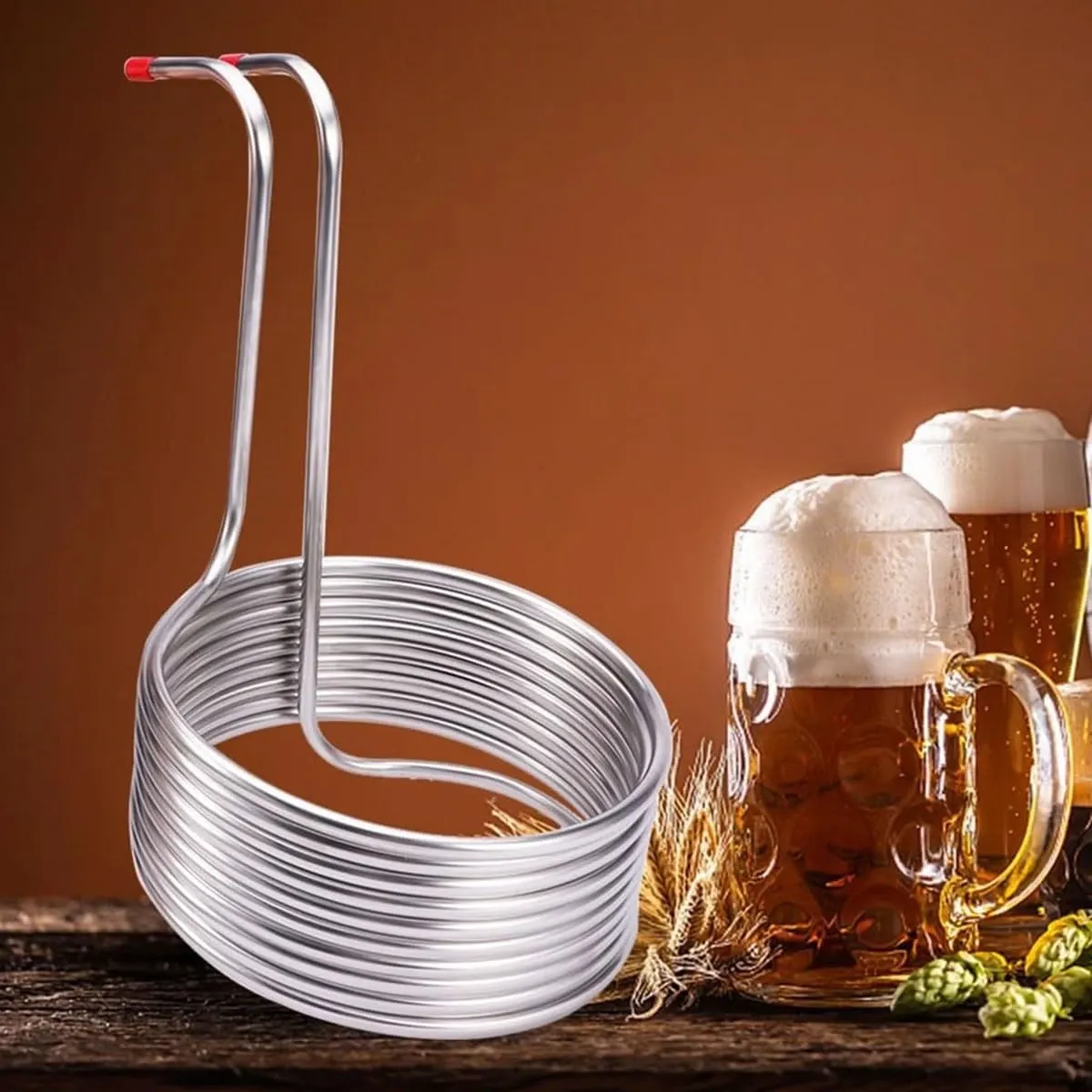
What to establish before buying either hose
BeerCoolin lists “Standard UK Hose Brass Adapters (Included)”. That is a useful starting description for an enquiry, but it does not identify the mating dimensions or establish a particular BSP, GHT or Hozelock interface.
Make a two-hose shopping record
Use this proposed worksheet when asking BeerCoolin and accessory suppliers to assess your setup. Complete each column separately, even if you are considering the same hose for both jobs.
| Detail | Cold-water inlet | Heated-water outlet |
|---|---|---|
| Equipment | Exact chiller model and inlet fitting | Exact chiller model and outlet fitting |
| Both ends | Tap-adaptor outlet and chiller connection | Chiller connection and intended open discharge arrangement |
| Dimensions | Confirmed hose inside diameter, any required outside diameter and proposed length | Confirmed hose inside diameter, outside diameter needed for the holder and proposed length |
| Conditions | Supply pressure and inlet-water temperature | Discharge temperature range and pressure conditions |
| Ratings | Working pressure at the intended water temperature | Continuous temperature limit and allowable working pressure at that temperature |
| Other parts | Matching connectors, seals and any specified clamps | Matching connectors, seals, any specified clamps and sink restraint |
| Instructions | Assembly and checking instructions | Assembly, routing, restraint and checking instructions |
For tap-adaptor identification, use the kitchen-tap connection guide. This article follows the hose purchasing decision from those connections to the sink discharge.
The worksheet is a proposed comparison method. It does not approve a particular assembly or replace its manufacturers’ instructions.
Match hose sizes to the actual connections
BeerCoolin lists the coil tube outer diameter as 9.52 mm (3/8"). Its product FAQ says: “The chiller comes with standard garden hose brass fittings.” Record these as separate facts: the tube measurement is not a stated hose inside diameter.
Ask which surfaces actually connect
Before selecting a hose size, ask the equipment and hose suppliers to identify the complete connection arrangement. Use the following as a proposed specification request for both the inlet and outlet:
- Chiller fitting: connection type, mating dimensions and a matching connector part reference.
- Threaded interface, if present: thread standard, nominal size, male/female arrangement and sealing method.
- Click or push connection, if present: exact connector series and matching part reference.
- Hose connection: specified inside diameter and tolerance, plus outside diameter where relevant to the connector or clamp.
- Attachment: the specified connection method and any required clamp type, size range and installation instructions.
Request a labelled drawing or photograph showing which dimensions belong to each interface. Do not turn the coil’s 9.52 mm outer diameter into a hose purchase size without confirmation of the intended connection.
Confirm the contents of the package
The listing identifies brass hose adaptors as included. The supplied passages do not itemise whether hoses, hose-end connectors, seals, clamps, a kitchen-tap adaptor or a sink restraint are included. Keep those items marked unconfirmed, rather than assuming they are supplied or excluded.
A useful enquiry is: “For this exact chiller, please identify the inlet and outlet mating connectors, required hose dimensions, sealing and attachment methods, and every supplied accessory.” Ask for documentation supporting the proposed parts before carrying them into the rating checks below.
Check the inlet hose’s working-pressure specification
Request the published allowable working pressure for the exact inlet hose size at the intended water temperature, together with the limits for its assembled connections. No numerical pressure threshold or exact inlet hose can be recommended from the supplied information.
Use these proposed purchasing questions with the hose supplier:
| Check | What to ask |
|---|---|
| Product identity | Which manufacturer, product code, hose size and construction does the document cover? |
| Working pressure | Where is the allowable working pressure stated for this exact size? Please identify that entry explicitly if the document also gives a burst-pressure figure. |
| Temperature | At what water temperature does the rating apply, and what limits cover the intended inlet-temperature range? |
| Connections | Which connectors, seals and attachment method are specified? |
| Complete assembly | What pressure and temperature limits apply to the proposed assembled combination? |
| Restrictions | What installation and operating conditions must be observed? |
Establish the conditions you need to match
Record the actual supply point and every proposed component between it and the chiller. Our recommendation is to ask a suitably qualified plumbing professional to establish the relevant pressure and temperature conditions and explain how they were determined. This article provides no verified measurement procedure or assumed UK household pressure value.
Give those conditions and the connection details to the hose supplier. Ask them to identify the manufacturer’s documentation supporting the proposed assembly. Ask BeerCoolin separately for the chiller’s permitted inlet conditions.
Our proposed acceptance rule is to leave the inlet hose unselected until the documented assembly limits have been matched to the established supply conditions. A general garden-hose fitting description does not answer this rating enquiry.
Check discharge temperature and pressure together
For the outlet hose, request a continuous hot-water temperature limit and an allowable working pressure at the intended discharge temperature for the exact size being considered. Treat these as paired purchasing checks. The available material does not establish BeerCoolin’s discharge-temperature range, discharge pressure conditions or a matching hose specification.
A customer review on BeerCoolin’s product page reports that “the outlet pipe gets incredibly hot for the first two minutes”. This is an individual account without a measured temperature or pressure. It provides no numerical hose rating and no basis for treating the outlet as cool after that period.
Keep the unknowns visible
Use this proposed specification table with BeerCoolin and the hose supplier:
| Required detail | What needs documenting | Current position |
|---|---|---|
| Discharge conditions | Temperature range and pressure conditions during the intended cooling cycle | Not established for BeerCoolin here |
| Exact hose | Manufacturer, product code, inside diameter, wall thickness and construction | No candidate verified |
| Continuous service | Continuous hot-water temperature limit and any duration or service restrictions | Applicable datasheet unavailable |
| Pressure at temperature | Allowable working pressure at the intended temperature for that exact size | No numerical recommendation supported |
| Complete assembly | Limits for the hose, connectors, seals and attachment arrangement together | Requires confirmation |
Ask: “For this exact hose size, what working pressure is permitted at the intended discharge temperature, and where is that combination documented?” If the supplier provides separate headline pressure and temperature figures, request confirmation of their permitted combination before accepting the candidate.
Why a material name is insufficient
“PVC” and “silicone” name materials; neither label states the size-specific pressure and temperature information requested above. “Reinforced”, “braided” and “high temperature” also leave those fields unanswered. As a proposed buying rule, require the relevant product documentation rather than treating any of these descriptions as the acceptance criterion.
This assessment does not establish that every hose of a particular material is suitable or unsuitable. No applicable hose datasheet has been supplied to support such a conclusion. There is also no measured BeerCoolin discharge temperature or universal numerical temperature requirement established here.
Keep the discharge directed into the sink
Ask suppliers to assess both the chiller-to-hose joint and the restraint holding the discharge end at the sink. No particular clamp, holder or mounting arrangement is verified for BeerCoolin by the available information.
Use the following as a proposed assessment brief, rather than an installation procedure:
| Component | Confirmation to request |
|---|---|
| Outlet connection | Exact matching connector, hose size, sealing method and assembly instructions |
| Hose attachment | Whether a clamp is required; if so, its specified type, size range, position and tightening instructions |
| Sink restraint | Exact model, compatible hose outside diameter, permitted service temperature, mounting surface, attachment method and documented holding arrangement |
| Hose route | Suitable length, bends and support positions under the hose maker’s instructions |
| Discharge end | A documented position that holds the end directed into the basin while leaving its opening unobstructed |
Show the complete proposed route
Send suppliers a labelled sketch or photographs showing the chiller outlet, worktop edge, hose route, sink, proposed support points and mounting surface. Identify the hose and holder models. Ask them to assess whether the arrangement avoids pulling on the chiller connection, pinching the hose or blocking its opening.
The intended outcome is an attached hose with a separately supported discharge position and an open end directed into the basin. Those are proposed acceptance criteria; they do not prove that a particular arrangement will remain stable during hot discharge.
Our proposed buying rule is to leave the restraint unresolved until its applicable temperature, hose fit, mounting method and holding arrangement are documented for the proposed use. Do not select a clamp size or sink holder from its appearance alone.
Check the assembly with water before brewing
BeerCoolin’s kitchen-tap guide advises: “Check dimensions, compatibility and the maker's instructions before use.” A detailed manufacturer-supported water-check procedure for the complete BeerCoolin hose-and-restraint assembly is not available in the supplied passages.
Use the following as a proposed observation checklist alongside the applicable manufacturers’ instructions. It supplies no test pressure, flow setting, duration, shutdown procedure or repair method. Obtain those instructions and confirm the components’ suitability before running a rehearsal.
- Identify the parts and conditions. Record the chiller, hoses, connectors, seals, any clamps and restraint. Confirm which assembly and checking instructions apply, and record the water conditions used.
- Inspect the route before water flows. Trace both hoses. Look for visible kinks, trapped sections, tight bends and sideways pull at connections. Compare the route and support positions with the applicable instructions. Check that the discharge opening is unobstructed and directed into the sink.
- Observe joints during the prescribed check. Follow the manufacturer’s water-check sequence. Record any dripping or escaping water at each accessible connection; do not assume that extra tightening is the correct response.
- Observe movement and discharge. Record whether a hose shifts, a connection is pulled, a kink appears, the restraint moves or water leaves the intended sink area.
- Resolve failed or uncertain observations. Our proposed rule is to end a failed rehearsal using the instructed shutdown method and keep the assembly out of brewing use until the issue is resolved. Obtain the relevant supplier’s corrective instructions, then repeat the prescribed checks after supported corrections.
Record what the check actually establishes
A useful observation is “no visible joint leakage during this water-only check”, accompanied by the conditions and duration. A cold-water rehearsal does not verify behaviour at the intended hot-discharge temperature.
Our proposed criterion for proceeding is therefore twofold: documented suitability of the complete assembly for the intended service, and completion of its prescribed checks without unresolved faults. Where either remains unanswered, request product-specific guidance before brewing.
Cleaning and sanitising remain separate first-use tasks; this observation checklist does not replace their applicable instructions.
What BeerCoolin still needs to confirm
The exact hose sizes, assembly limits and suitable sink restraint remain unresolved. The available information supports a targeted purchasing enquiry, rather than an exact product shopping list.
Ask BeerCoolin to confirm:
- Both connections: labelled dimensions, connection standards, mating parts and sealing arrangements for the inlet and outlet.
- Required hoses: inside diameter, any relevant outside diameter and specified attachment methods.
- Operating conditions: permitted inlet pressure and temperature, plus the discharge conditions the outlet assembly must accommodate.
- Package contents: an itemised list distinguishing supplied parts from hoses, connectors, seals, clamps and restraints to buy separately.
- Assembly and checking instructions: applicable routing, restraint, water-check and failed-check guidance.
Ask the accessory suppliers to provide the corresponding hose ratings and complete assembly limits, and documentation for the proposed holder’s temperature suitability and mounting arrangement.
BeerCoolin’s contact page lists email and WhatsApp Business contact options. Send the exact model, photographs of both connections, your proposed layout and any candidate accessory references. Request written specifications or applicable instructions; a product enquiry alone does not confirm compatibility.
Your buying and setup checklist
Use this proposed record to keep each decision open until its supporting information is available:
- Before ordering: confirm the connection specifications, exact hose references and dimensions, and ratings matched to the established operating conditions.
- Before assembling: reconcile the package contents with the shopping list and obtain instructions for every chosen connection and restraint.
- Before a water rehearsal: obtain the prescribed checking conditions, sequence, shutdown method and responses to failed observations.
- Before hot use: confirm the complete assembly’s suitability for the intended discharge conditions separately from any cold-water observations.
Keep unresolved entries marked as such. The worksheet provides a way to compare candidates and request precise answers; it does not make an undocumented combination suitable for use.
View the BeerCoolin Pro — £51.83
References
- Connect Wort Chiller to Kitchen Tap UK | Beercoolin
- Contact Us | BeerCoolin
- BeerCoolin Pro Beer Wort Chiller | Fast Cooling Coil